
Compliance Study on Tiger26 Formula SAE Suspension
As a new member of the Clemson Formula SAE team with previous experience for CU Boulder’s Formula SAE team I decided to take on the task of verifying our suspension compliance targets. These targets were set years ago for a Formula SAE car that was over built and we hadn’t verified these targets with our previous T25 car.
Compliance in suspension terms is how much the vehicle is deforming under load, and my job was to study how much the compliance of the suspension components affect our target kinematics. For this I would be looking at ride compliance and handling compliance, or how the car acts vertically with bumps, braking and acceleration, and laterally with turning.
By knowing the compliance in our suspension we will be able to better understand our ideal setup windows and understand in future years which components needs to be strengthened to not only meet Factors of Safety but also compliance targets.
Project Background
Project Objectives
Ride
Study the effects of compliance on wheel rate and system spring rates and dampening ratio
Evaluate 2D model of suspension ride versus logged data and make needed edits to the model
Determine vertical compliance for future designs
Handling
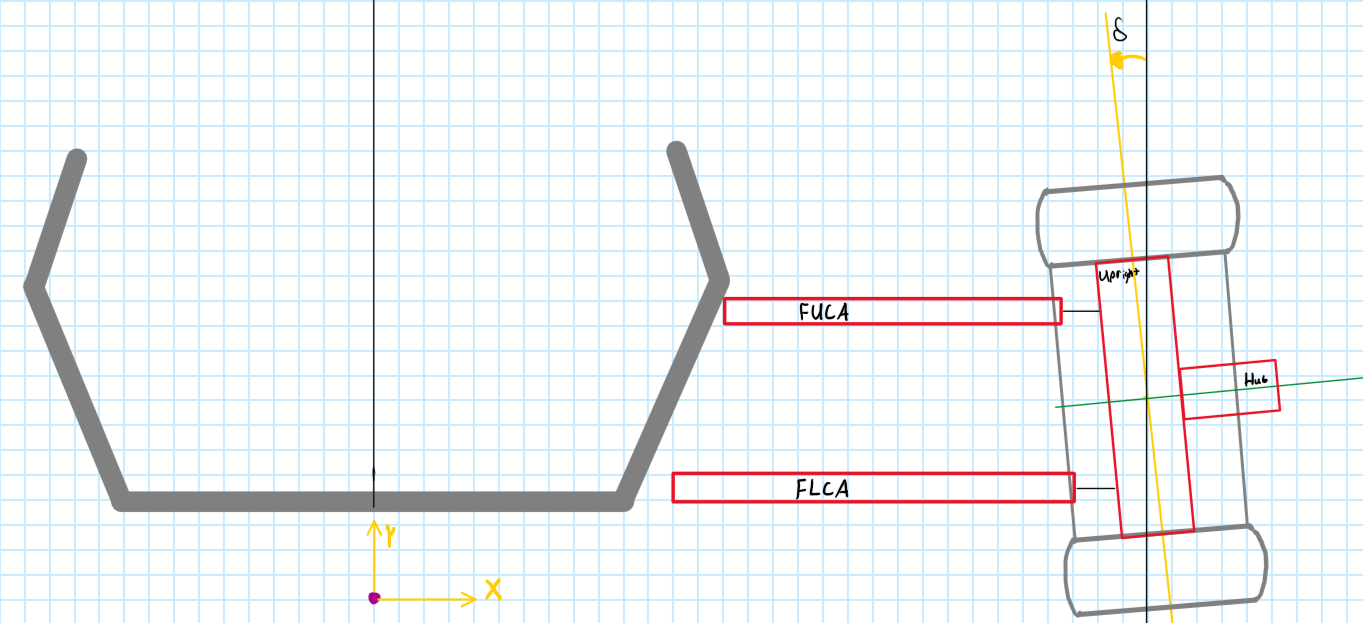
Create Excel sheet tracking individual deformation in FEA of suspension components
Derive deformation stack up values through suspension system in XYZ direction
Analyze effect of deformation in XYZ on camber, toe, and steering angle under used load cases
Modeling Ride Characteristics
For my ride model I was going to use a half car model where the front and rear axle would be one unit. This would simplify the model and make it easier to evaluate while still giving useful information into how the compliance affects the suspension in the Z direction.
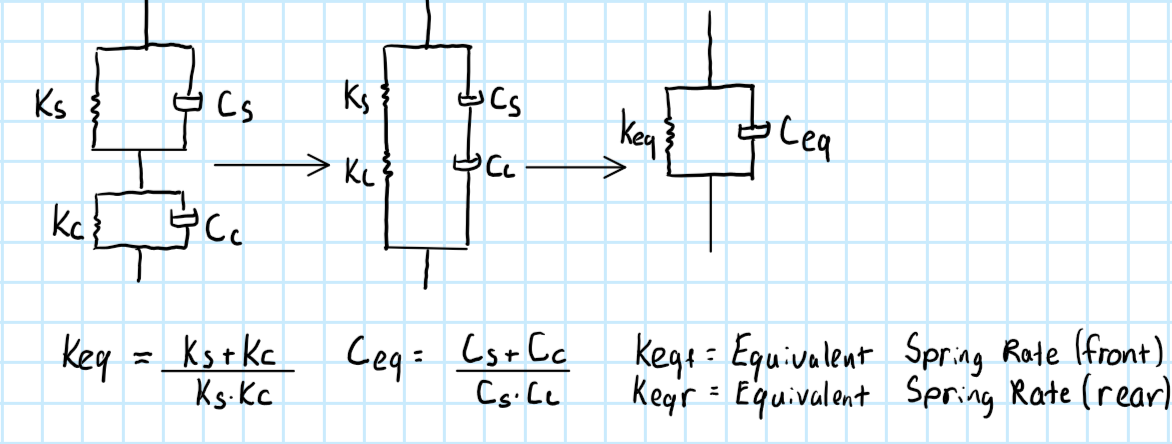
In this model there is the front and rear spring stiffness and dampening ratio for the suspension, tires, then the compliance. The deformation of the components acts as spring mass damper system while it deforms, it will expand or contract then return to its original state. The spring stiffness and dampening ratio of the suspension and compliance can be modeled in series giving an equivalent stiffness to simplify the derivation.
I set the system up as an Ordinary Differential Equation then set it to solve for sprung and unsprung positions, velocities and accelerations of different points on the vehicle. This will allow me to see give the system an input and analyze the behavior of the body with eigen values, settling time, and dampening ratios.
Equivalent Spring Stiffness and Dampening Ratio Derivation
Analysis of Ride Compliance
In order to analyse the half car model I used MATLAB with the solved half car model ODE in the state space. Using the transfer function I evaluated 2 different cases. The first cases was traveling at 40 mph and hitting a bump 15 mm tall and 20 mm wide for a bump case. The second case was a hard braking and lift case where the car would be traveling at 40 mph and brake hard and then lift off the brake at 20 mph. I chose these two cases because these are very normal cases for the car to see while driving and can have great effects to vertical stability and ability to control pitch. The analysis involved using 5 different equivalent spring rates and damping ratios along with 5 different unsprung mass values. This study is intended to see the effects of mass and compliance in a system giving insight into the trade off of mass and deformation.
For the equivalent dampening, spring rate, and mass values I research SAE paper on compliance along with some experimenting with changing the tube thickness on our previous control arms to come up with the 5 different cases. The most extreme case was to show extreme chassis rigidity with an unsprung mass multiplier of 1.3X. Then on the other end of the spectrum I had the extreme compliance case with very little chassis rigidity and an unsprung mass multiplier of .8X. The other 3 cases were in the middle and the main 3 that I would be looking at, the other two were to exagerate the effect of mass and system compliance.
Current Progress of Project
Both the ride and handling compliance project are still in a work in progress.
For the ride analysis I am waiting for an updated aero map so that my model can more accurately show the effect of pitch on the car as it oscillates and settle to its original ride height
For the handling analysis I am still working on deriving the functions that will calculate the total change in steering angle, caster, camber, and toe of the car while under load.
Both of these projects will be completed prior to Michigan Formula SAE competition in May so that we can present our finding to judges.